
The Expectation of Strength After “Doing the Work”
There’s this quiet expectation that comes with healing.
Once you’ve “done the work,” and you’ve survived the worst of it, when you can name your trauma and talk about it without completely falling apart… you’re supposed to be strong.
Resilient. Grounded. And self-aware.
The Pressure of Being the One Who Knows Better
You’re the one who breathes through it now. The one who pauses instead of reacting. The one who intimately understands your triggers, your patterns, and the frantic language of your own nervous system.
And who do you become? The one who knows better.
Most days, you can be that person. But there are days where you feel like screaming from the rooftops, “Not today.” Because on those days, you don’t want to be strong.
Emotional Intelligence Is Exhausting, Actually
You don’t want to be the most emotionally intelligent person in the room. You don’t want to regulate yourself. And you definitely don’t want to “gently parent” the parts of you that are loud, messy, and inconvenient.
In fact?
You kind of want to tell everyone and everything to fuck off.
There’s a specific kind of fatigue that comes from constantly catching yourself. From noticing every micro-shift in your chest. From being the one who always has to stop, breathe, and choose the “healthy” response. It’s like being your own parent, therapist, and crisis manager 24/7.
And at some point, it just gets… exhausting.
For a deeper dive into why this happens and how it shows up in CPTSD, see this article on emotional exhaustion and CPTSD.
You Can’t Unknow What You Know
It’s not the healing itself that wears you out. It’s the responsibility of it.
Because once you know, you can’t unknow. You see the patterns. You feel the triggers before they even land. You recognize the exact moment you’re about to spiral, shut down, people-please, or disappear.
And now? It’s on you to do something different. Every. Single. Time.
No one really tells you that part, that healing doesn’t just give you peace; it hands you a lifetime of constant accountability. It’s a quiet voice in the background saying, “You know what this is. You know where this goes. You have to choose the hard way.”
The Days You Just… Don’t Want To Try
And most days, you listen. Most days, you show up for yourself in ways you never were shown before, and definitely not as a child.
But some days? You don’t want to take the pause. You don’t want to be the “bigger person.” You want to be petty. Reactive.
You want to let the five-year-old version of you finally have their say, without the “adult” version of you stepping in to mediate.
Not because you’ve lost your progress. But because you’re tired of carrying it so well.
The Grief Beneath the Growth
There’s a grief in that, too.
Grief for the version of you that didn’t have to think this hard about existing. Grief for the ease that never really came naturally. And the grief for how much effort it takes just to feel… okay.
I’ve been there, and many of you will have been there too.
On the days you simply want to be, without the analysis, without the management, and without the constant manual override of your own shadow, know that it’s okay to just be tired.
Healing is a marathon, but no one said you aren’t allowed to sit down on the curb for a while.
You’re Allowed to Just Be
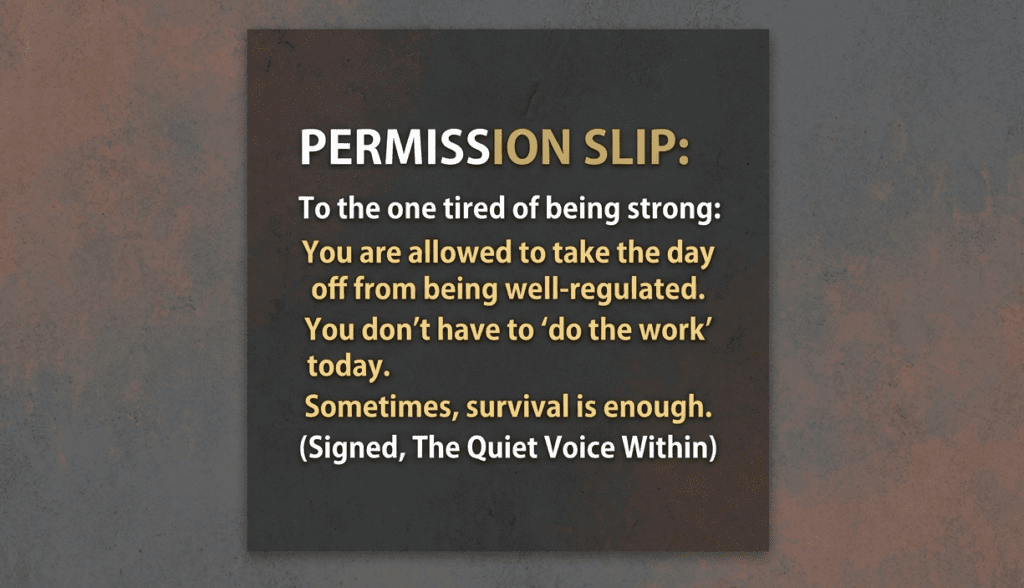
So, this is your permission slip.
You are not failing your recovery if you take a day off. You are allowed to take the backpack off and just be, even if that “being” is messy, reactive, or incredibly sad. Sometimes, survival is “the work.”
The awareness will still be there tomorrow. The accountability isn’t going anywhere. But for now? Breathe, if you want. Scream, if you need to. And rest.
A Final Note for the Community
I’d love to hear from you in the comments (or over on socials). Which part of “the work” feels the heaviest for you right now? Is it the constant self-regulation, or the grief for the person you were before the awareness kicked in?
Let’s talk about the parts of healing that aren’t “pretty.”
This came just at the time I needed it most. This describes exactly where I am now. Iv been doing the work for a long time and i hoped to be more healed by now. It’s a lifelong journey but I can’t help but think what it would be like to live in a world without developmental trauma or CPTSD and ADHD. I didn’t choose those life but nonetheless here. I am. But thank you, thank you so much for your monthly posts, I am grateful 🙏
I really hear you.
That feeling of “I should be further along by now” is so common when you’ve been doing this work for a long time, but it doesn’t mean you’re behind or failing.
You didn’t choose any of this, but the fact you’re still showing up and doing the work matters more than it probably feels like some days.
I’m really glad the posts are helping, even a little.
Jack, I’ve read, reread, and revisit this article numerous times over the last few weeks to great comfort and validation. I was sharing with my T the importance for me right now in humanizing my healing. It’s super easy for me to feel like I have a clinical case of being misunderstood by myself and by others.
This article hits exactly where I am in my recovery. Learning to balance the doing the hard work with the being of a human. Like the article says, the continuous emotional regulation is exhausting and can easily shift into absolute thinking. I am fortunate to have the burden of awareness / mindfulness. It doesn’t always feel like a fortune. More like a debt.
Your share put it in perspective. Not just that the work is ‘hard’ or is constant. It’s an emotional labor that is reminiscent of what we came thru. I’ve found very few people can relate to this concept and the heaviness of it. In fact, I’ve shared with my T that you’re the first person in recovery that I can relate to. Few make it to this stage understandably. Learning to be gentle with myself and to anchor to others wisdom as its new territory for me as a 52 year old!
Thanks again for sharing your time, energy and healing.
That really means a lot to read, thank you for sharing it.
I hear you on the exhaustion of awareness and that feeling of becoming “clinical” in your own healing. Learning to stay human in it is hard work.
I’m really glad it’s brought you some comfort and validation.
This is exactly where I am right now and I’m utterly exhausted. I have been taking this time to rest, to be in solitude and just allow myself to be. Sounds easy, it isn’t. But it is becoming easier. I’ve been really sad, irritable and unmotivated lately and it is definitely from the constant “work” of healing. But now little by little, I just let myself feel whatever I’m feeling and there is a sort of “rest” in that. I don’t always have to feel, think, act or have a belief system that is “right” or “healthy”. Part of being healthy is not pressuring myself to be the “healthier” version all the time. It’s ok to fall apart for a while and then guess what? You’re completely ok!
Healing isn’t just insight and breakthroughs, it’s work. Emotional, physical, nervous-system-level work that doesn’t clock out at 5pm.
And honestly, taking time to rest, however that looks for you isn’t stepping back. It’s part of the work too.
You’ve got this!