Complex PTSD: It’s Not Just ‘Regular’ Trauma, and That’s Okay.
Complex Post-Traumatic Stress Disorder, or CPTSD, is like PTSD’s tougher, more complicated cousin. While PTSD usually comes from a single traumatic event, CPTSD develops after prolonged or repeated trauma. We’re talking long-term abuse, neglect, captivity, or any situation where you felt trapped, powerless, and under constant threat.
This isn’t just one bad moment. It’s layers of trauma, stacked up over time.
People living with CPTSD often deal with flashbacks, intense anxiety, mood swings, and deep struggles with trust. There’s usually this constant, low-level hum of hypervigilance, like your brain is stuck in “survival mode,” always scanning for danger even when you’re safe. And let me tell you, that’s utterly exhausting.
 CPTSD vs. PTSD: What’s the Difference?
 CPTSD vs. PTSD: What’s the Difference?
It’s Not Just One Bad Day, It’s a Whole Pattern of Pain. The key difference isn’t just severity, it’s duration and complexity:
- PTSD: Usually results from a single, time-limited event (e.g., car accident, natural disaster). The focus is on the specific event memory.
- CPTSD: Develops from prolonged, repeated trauma (e.g., childhood abuse, long-term emotional neglect). The impact is deep, pervasive, and often shapes the individual’s entire identity and worldview.
With CPTSD, it’s not one memory, it’s a whole environment, a pattern, a chapter of life. And that kind of trauma leaves a different mark.
How Does CPTSD Show Up in Daily Life?
Living with CPTSD doesn’t just mean managing symptoms. It means learning to navigate everyday life while carrying a history that shaped how you see yourself, others, and the world around you. Things like relationships, work, or even simple daily tasks can feel overwhelming. Some days, getting out of bed and showing up for yourself is a huge win. And you know what? It counts.
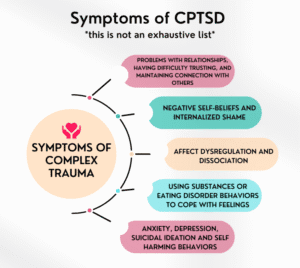
1. Emotional Regulation Challenges:
- Extreme mood swings and chronic irritability. [Feeling like a mess? Read my blog posts on navigating intense emotions.]
- Difficulty controlling feelings of rage or intense sadness.
- Persistent feelings of emptiness or helplessness.
2. Disturbance in Self-Perception:
- Profound, pervasive shame and guilt. [Check out the Q&A with a therapist on overcoming the inner critic.]
- Feeling permanently damaged or broken.
- Low self-worth and a feeling of being totally different from others.
3. Relational Issues:
- Deep-seated difficulty with trust and vulnerability.
- Tendency toward isolation or withdrawal.
- Seeking out unhealthy relationships (re-enactment).
4. Hypervigilance & Dissociation:
- Constant feeling of being “on edge” or scanning for danger (hypervigilance).
- Frequent daydreaming or feeling disconnected from your body (dissociation).
What Causes CPTSD?
CPTSD doesn’t come from one bad day, it comes from an environment. Usually one where you were trapped, powerless, or unable to escape the source of harm. Common roots include:
- Childhood abuse or neglect (physical, emotional, or sexual)
- Growing up with an unpredictable or unsafe caregiver
- Domestic violence or long-term intimate partner abuse
- Human trafficking or captivity
- Prolonged exposure to war, conflict, or community violence
The common thread isn’t the specific event, it’s the repeated, inescapable nature of it. Your nervous system adapts to survive an unsafe world, and those adaptations stick around long after the danger’s gone.
Can CPTSD Be Treated?
Short answer: yes. It takes time, and there’s no single fix that works for everyone, but healing is genuinely possible. Approaches that are commonly used include:
- Trauma-focused therapy (like EMDR or somatic experiencing) to help process stuck memories
- Talk therapy to rebuild trust, self-perception, and relational patterns
- Body-based practices (yoga, breathwork, grounding techniques) to calm a nervous system stuck in survival mode
- Medication, for some people, to manage symptoms like anxiety or depression alongside therapy
I’m not a clinician, so I can’t tell you which is right for you, that’s a conversation for a licensed therapist. But if you’re looking for a place to start, check out my resources page.
Frequently Asked Questions
Is CPTSD the same as PTSD?
No. PTSD usually comes from a single traumatic event. CPTSD comes from prolonged, repeated trauma, and it tends to affect identity, self-worth, and relationships more deeply.
Is CPTSD a recognized diagnosis?
CPTSD is recognized in the ICD-11 (the World Health Organization’s diagnostic manual). It’s not currently a standalone diagnosis in the DSM-5 (used mainly in the US), though many clinicians recognize and treat it.
Can you fully recover from CPTSD?
Recovery looks different for everyone. Many people go on to live full, connected lives, but “recovery” is usually less about erasing the past and more about no longer being ruled by it.
What’s the difference between CPTSD and BPD?
They can look similar on the surface (both involve emotional intensity and relationship struggles), but CPTSD is trauma-based, while BPD is a separate personality disorder with its own diagnostic criteria. A professional can help sort out which fits, if either.
Your Story Matters (The Conclusion)
Here’s what I want you to hear, especially if this is your reality: yes, CPTSD is tough. It’s messy and unpredictable. But there is also a quiet, powerful strength in surviving what you have. Healing doesn’t happen overnight, and there’s no one-size-fits-all roadmap. But it is possible. Slowly, steadily, you can start to feel safer, more grounded, and more connected to yourself and to the people who truly see you.
So if you’re living with CPTSD, please remember this:
You are not alone. Your story matters. Your healing matters. And you deserve a life that feels good to live.
📘 Ready to explore your healing journey?
Grab your free CPTSD workbook filled with journaling prompts and self-guided support.
Find Me On Socials!