What Causes CPTSD? Understanding Complex Trauma
Complex PTSD (CPTSD) can develop after prolonged or repeated trauma, particularly when a person feels trapped, powerless, or unable to escape what is happening.
Unlike trauma caused by a single event, CPTSD is often connected to experiences that happen repeatedly over time, such as childhood abuse or neglect, domestic violence, captivity, chronic emotional abuse, or growing up in an unpredictable and unsafe environment.
What matters is not simply what happened, but the repetition, the lack of control, and the way the nervous system had to adapt in order to survive.
For me, understanding that changed the way I looked at many of my own reactions. Things I had spent years judging myself for—hypervigilance, emotional overwhelm, difficulty trusting people—started to make more sense when I understood where they came from.
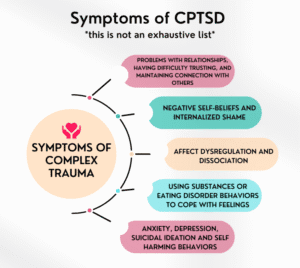
For many people with CPTSD, the effects of trauma are not always obvious. They can show up as difficulty trusting others, feeling constantly on guard, struggling to regulate emotions, or feeling disconnected from yourself.
People living with CPTSD may experience emotional flashbacks, intense anxiety, difficulty with trust, and a persistent sense of being on alert. There can be a constant, low-level hum of hypervigilance, as if your brain is still scanning for danger even when you are finally safe.
And that is exhausting.
CPTSD vs. PTSD: What’s the Difference?
 PTSD and CPTSD share many of the same core trauma symptoms, including intrusive memories, avoidance, and a heightened sense of threat.
The difference is that CPTSD also includes longer-term difficulties with emotional regulation, self-worth, and relationships.
CPTSD is particularly associated with prolonged or repeated trauma, although PTSD can also develop after repeated traumatic experiences. The distinction is not simply “one event versus many.”
With CPTSD, trauma can shape more than your memory of what happened. It can affect how you see yourself, how safe you feel around other people, and how your nervous system responds to everyday situations long after the original danger has passed.
How Does CPTSD Show Up in Daily Life?
Living with CPTSD does not just mean managing a list of symptoms. It can affect relationships, work, self-esteem, emotional regulation, and the way you move through everyday life.
Emotional Regulation
Emotions can sometimes feel much bigger than the situation in front of you. You may experience intense sadness, irritability, anger, anxiety, or emotional overwhelm without immediately understanding where it came from.
Shame and Self-Perception
CPTSD can create a deeply negative view of yourself. Shame, guilt, low self-worth, and the feeling that something is fundamentally wrong with you can become difficult patterns to break.
Trust and Relationships
Trauma can make closeness complicated. You may crave connection while also fearing it, struggle with vulnerability, withdraw when you feel unsafe, or find yourself constantly watching for signs that someone might leave or hurt you.
Hypervigilance and Dissociation
Some people remain constantly alert to danger, noticing changes in tone, facial expressions, body language, or the atmosphere in a room.
Others may disconnect from what they are feeling altogether. Dissociation can feel like zoning out, feeling detached from your body, losing track of time, or experiencing the world as slightly unreal.
What Causes CPTSD?
CPTSD is most strongly associated with prolonged or repeated trauma, especially when escape is difficult or impossible.
Common experiences linked with CPTSD can include:
- Childhood physical, emotional, or sexual abuse
- Emotional or physical neglect
- Growing up with an unpredictable or unsafe caregiver
- Long-term domestic or intimate partner abuse
- Human trafficking or captivity
- Prolonged exposure to war, conflict, or violence
The important part is not that every person with CPTSD has the same story. It is that the nervous system may spend a long period adapting to an environment that does not feel safe.
Those survival adaptations can remain long after the danger itself has ended.
Can CPTSD Be Treated?
Yes. There is no single treatment that works for everyone, and healing is rarely linear, but CPTSD can be treated.
Approaches may include trauma-focused therapy, EMDR, cognitive therapies, body-based approaches, grounding techniques, and other forms of trauma-informed support.
Some people also use medication to help manage symptoms such as anxiety, depression, or sleep difficulties alongside therapy.
I’m not a clinician, so I cannot tell you which approach is right for you. That is something to discuss with a qualified mental health professional.
If you are looking for places to start, I have put together a collection of CPTSD books, communities, therapy resources, and support organizations on my resources page.
Frequently Asked Questions
Is CPTSD the same as PTSD?
No. They overlap, but CPTSD includes the core symptoms of PTSD alongside additional difficulties involving emotional regulation, self-concept, and relationships.
Is CPTSD a recognized diagnosis?
Yes. Complex PTSD is recognized as a diagnosis in the ICD-11, published by the World Health Organization. It is not currently listed as a separate diagnosis in the DSM-5-TR, which is widely used in the United States.
Can you fully recover from CPTSD?
Recovery looks different for everyone. For many people, healing is less about erasing the past and more about reducing its control over the present.
Triggers may become easier to recognize, emotions easier to regulate, relationships safer, and the nervous system less likely to react as if danger is still happening.
What’s the difference between CPTSD and BPD?
CPTSD and borderline personality disorder can share some features, particularly emotional dysregulation and relationship difficulties, but they are not the same diagnosis.
CPTSD is a trauma-related disorder in the ICD-11, while BPD is a personality disorder with its own diagnostic criteria. They can also occur together.
I’ve written more about the overlap, the differences, and why getting the distinction right matters in BPD vs CPTSD: Why the Difference Matters.
Where Do You Go From Here?
Understanding what caused your CPTSD does not undo what happened, but it can change the way you understand your reactions.
For me, that shift mattered. Hypervigilance, emotional overwhelm, difficulty trusting people, and the constant need to scan for danger stopped looking like personal failures and started looking like adaptations.
That does not mean they have to control the rest of your life.
Healing can be slow, uneven, frustrating, and sometimes difficult to recognize while you are in it. But understanding why your nervous system responds the way it does can be an important part of learning how to work with it rather than constantly fighting against it.
If you’re looking for somewhere to start, I’ve put together a collection of CPTSD resources, books, support communities, therapy options, and practical tools that may help.
📘 Ready to explore your healing journey?
Grab your free CPTSD workbook filled with journaling prompts and self-guided support.
Find Me On Socials!